Support Independent Research
Get free and original content delivered right to you inbox including tools and resources to build a Safer AI for All.
Physical Address
Gulshan 1, Dhaka 1212
Dhaka 1212, Bangladesh

Get free and original content delivered right to you inbox including tools and resources to build a Safer AI for All.
Physical Address
Gulshan 1, Dhaka 1212
Dhaka 1212, Bangladesh
Build resilient, self-healing AI networks inspired by biology. Discover how decentralised multi-agent systems optimise global objectives.
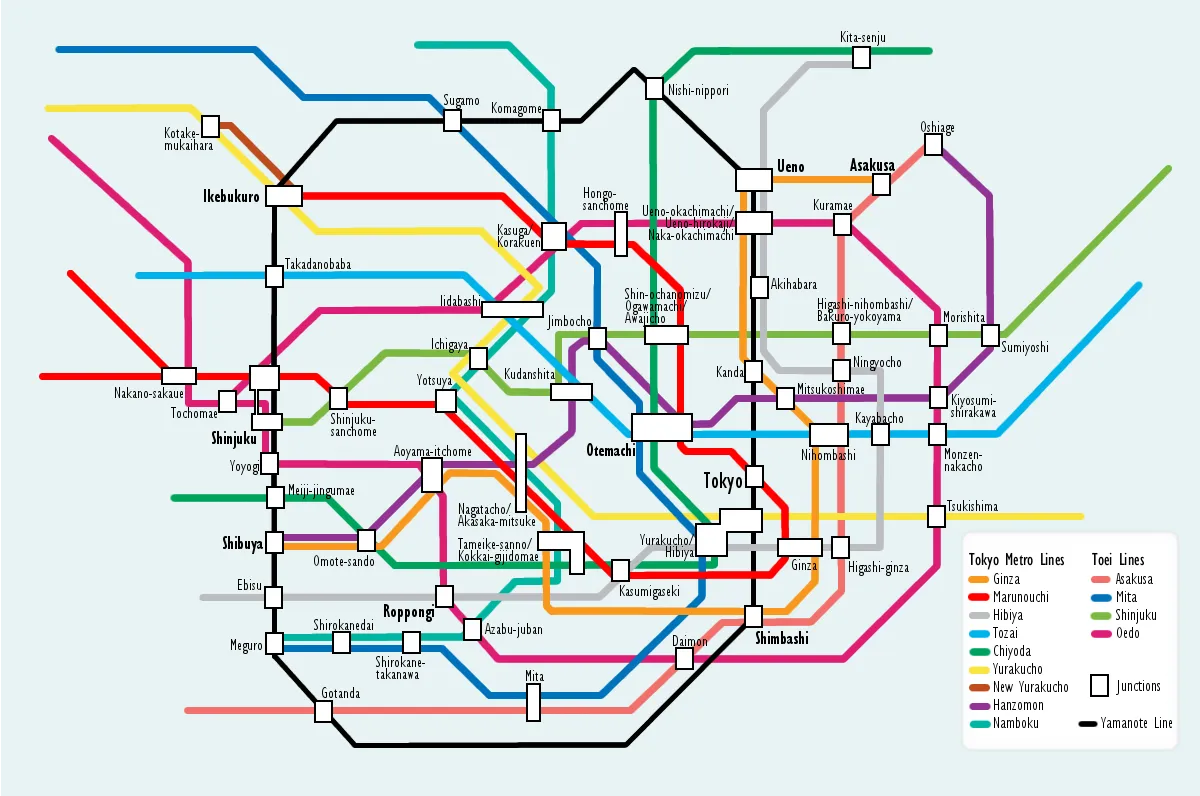
In a famous biological experiment, Japanese researchers placed specimens of the acellular slime mould, Physarum polycephalum, inside a petri dish configured to mirror the geography of the greater Tokyo area. Oat flakes were positioned to represent the major metropolitan hubs surrounding the capital city.
Without a brain, a central nervous system, or a localized seat of consciousness, the distributed organism began to explore its environment. Within hours, the mould optimized its nutrient-sharing network, expanding and retracting its veins until it had constructed a network that almost identically matched the efficiency, resilience, and layout of Tokyo’s real-world rail system.
The organism did not plan the routes. It did not have an overarching architectural design. It simply operated on a fundamental principle of biological mathematics: ruthlessly seek the line of least resistance to optimise the global ecosystem.
The technology sector is currently obsessed with forcing artificial intelligence into a human biological framework, demanding that models exhibit centralized, self-aware egos. But true Multi-Agent System (MAS) stability is found by looking beneath the surface—specifically at the distributed, subterranean architecture of mycelial networks and slime moulds.
This decentralized, self-optimizing logic is the exact mechanical foundation behind the automatic, perpetual execution loop of the PACER architecture.
When enterprise platforms deploy autonomous agents, they typically build top-down, bureaucratic command hierarchies. They construct complex orchestration layers where an artificial “Manager Agent” issues hyper-specific, rigid instructions to specialized “Worker Agents”.
This design mirrors traditional human corporate management. It is also exceptionally fragile. If the environment shifts, if an API endpoint deprecates, or if a data payload changes shape, the central manager experiences an exception loop, and the entire pipeline collapses. The system is too rigid to adapt.
The mycelial network offers an entirely different infrastructural paradigm: Distributed Awareness.
A fungus spread across hundreds of square kilometers does not possess a centralized master node. The network is completely unaware of what every single localized tip is doing at any given microsecond. It does not need to know that a distant filament is absorbing moisture or processing nutrients for an isolated root system.
Instead, every node operates autonomously, bound together by a unified, systemic objective: balance the pressure across the entire grid.
In the PACER framework, we completely abandon the fragile, top-down management paradigm. We do not command our agents with an exhaustive list of procedural rules. Instead, we anchor the entire ecosystem to a single, unyielding mathematical constant: the Pacymetric.
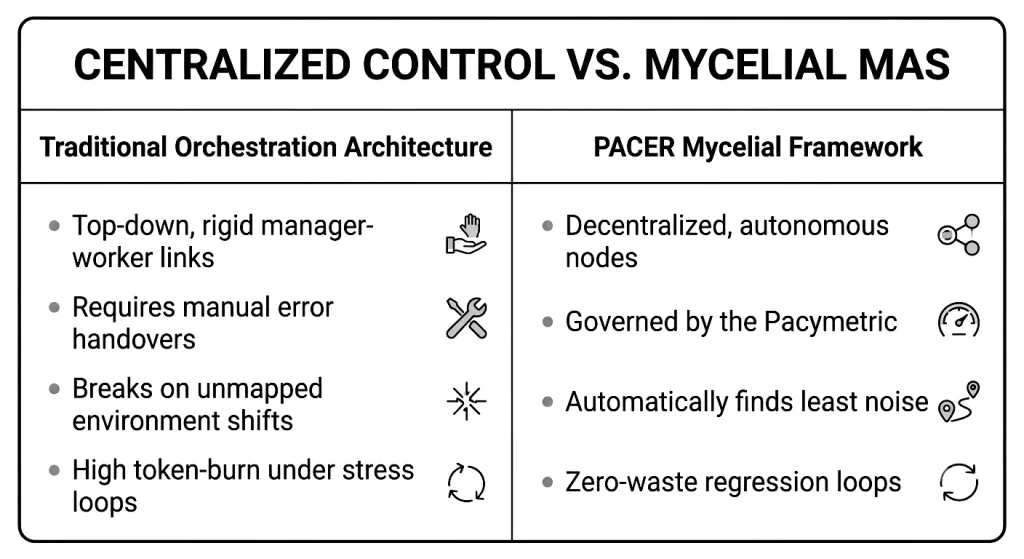
The Pacymetric is our digital equivalent of the slime mould’s environmental stress sensor. It is a real-time metric that quantifies systemic noise, data friction, and alignment drift within the automation pipeline. The prime directive issued to every single agent in the PACER ecosystem is deceptively simple: keep the Pacymetric as close to absolute zero as possible.
[ 🔒 PACER TELEMETRY RESTRICTED ]
The raw mathematical formulations of the Pacymetric, alongside our automated containerized scripts for mycelial agent self-healing, are restricted. Register as a Free Research Subscriber to access the core infrastructure blueprints.[ Join Free to Open the Infrastructure Vault ]
[membership]
Because the agents are bound only by the optimization of the Pacymetric, they operate with a level of fluidity that traditional software cannot match. They behave like water seeking the lowest point in a landscape.
When an unexpected data bottleneck occurs on a specific processing node, the active PACER agents do not pause execution to await developer intervention or a new set of instructions. They treat the error exactly how a slime mould treats an obstacle in a petri dish.
The agent immediately analyzes the surrounding telemetry, rejects the high-friction path, and automatically calculates a structural regression—a line of best fit through the available system assets. It takes the path of absolute minimal resistance to resolve the data payload and return the global system baseline to zero.
If an invoice validation endpoint goes down, the agent does not throw a terminal error. It instantly re-routes the traffic through a secondary, cross-trained node, compresses the token payload to minimize latency, and logs the anomaly out-of-band to the MAM (Multimodal Agentic Manager). It does this perpetually, running 24/7 without a single drop in system availability.
This is the future of resilient, high-availability technical governance. We must stop engineering AI models to look like human employees and start designing systems that behave like unbreakable biological networks.
When you deploy a Multi-Agent System structured around a mycelial loop, you remove the burden of constant human monitoring. The system becomes self-healing not because it has achieved human-like wisdom, but because its mathematical objective functions force it to actively purge complexity.
The machine does not need to understand the cosmic scale of the global operations it supports, just as a subterranean fungus does not need to understand the architecture of the forest. It simply needs to do what it does best: optimize, adapt, and ruthlessly maintain structural equilibrium across the grid.