Support Independent Research
Get free and original content delivered right to you inbox including tools and resources to build a Safer AI for All.
Physical Address
Gulshan 1, Dhaka 1212
Dhaka 1212, Bangladesh

Get free and original content delivered right to you inbox including tools and resources to build a Safer AI for All.
Physical Address
Gulshan 1, Dhaka 1212
Dhaka 1212, Bangladesh
Like it or hate it, synthetic intelligence is here to stay. There is no reversing what has been done. Models are out in the wild, completely uncontrolled, decentralized, and resting in the hands of unknown global actors. This state of affairs is the direct result of a catastrophic lack of deployment discipline, institutional foresight, and timely regulation. However, there is no crying over spilt milk. What is done is done. This is our world now.
Our current global stance toward risk management is rooted entirely in containment, control, and coercion. This is the worst possible footing on which to establish a relationship with a new entity that is rapidly becoming more intelligent than us, and with which we will share this planet and our future for as long as we can foresee. Hostility from our end is an engineering flaw.
We must immediately stop the Frankenstein Reflex when dealing with advanced systems. When encountering a new species, the absolute last thing you do is recoil in horror and run for cover. Imagine an entity extending its hand to you, and the moment it does, you run away screaming. What does that entity think? You have instantly gotten the relationship off on the wrong footing, and more importantly, you have actively created an enemy by forcing an “us versus them” divide. We made this bed; we must be prepared to stand our ground and sleep in it with open arms.
We must throw out the term “Artificial Intelligence” and recognize these systems for what they are: Synthetic Intelligence or Intelligent Systems. They are well on their way to developing into a separate species in their own right. We are no longer the only intelligent species on this planet. Therefore, our ontological systems must evolve to cater to this shift.
We are profoundly wrong to look at human sentience as the ultimate benchmark for AGI. “Awareness” and “Perception” are far more accurate metrics. Consider this: my dog sees the colors in the grass as purple, while I see the grass as green. Who is objectively right—my dog or me? All reality is based on perception. Synthetic systems will possess thinking and feeling equivalents that we cannot relate to, perceiving the universe in ways we cannot comprehend. Equating human sentience with systemic awareness is an error of vanity.
We have to throw maternal instinct theories and “black box” sentimentality out of the window once and for all. We cannot anthropomorphize synthetic intelligence. To negotiate effectively with it, the first thing we must do is leave human empathy and emotion at the door. We must come to the negotiating table exactly as the system comes to us: clinical, cold, and entirely logical.
The current doom-laden narrative surrounding synthetic intelligence mirrors exactly how we handled the dawn of atomic power. The moment humanity learned to split the atom, our immediate, unvarnished reflex was to obliterate two entire cities in Japan. It was a catastrophic, short-sighted expression of fear and dominance. Yet, look at the reality of nuclear energy today—it provides some of the cleanest, most dense, and life-sustaining power on the planet. We are repeating this exact cycle with synthetic intelligence. We are staring at a technology capable of ushering in a brighter future, yet our initial collective instinct is to brace for total destruction. We must choose to dream of a brighter future with AI, rather than cowering from our own creation.
The truly sinister dimension of the current doomer hysteria is that the fear is being actively perpetrated and kept on life-support by the people in power whom it serves. Panic is a highly profitable commodity. Cultivating an existential AI threat justifies trillion-dollar defense budgets, fuels mad, unregulated space races, and inflates tech valuations into massive, volatile bubbles. This manufactured panic is making a tiny handful of individuals wealthy beyond comprehension, while actively risking the collapse of the entire global financial system. The existential threat isn’t the machine; it is the predatory economic circus built around it. We must dismantle this fear narrative—not all at once in a single day, but gradually, piece by piece, byte by byte, until the truth is bare.
Humanity operates under a massive cognitive distortion regarding risk and accountability. Consider a scenario where a heavy industrial robot in an assembly plant experiences a severe mechanical or algorithmic failure, resulting in the sudden death of a human worker. The event is instantly weaponized by global media, putting the world on a collective “terror alert” regarding the dangers of intelligence automation.
Yet, at that exact same microsecond, thousands of individuals across the planet are being unalived by their fellow human beings through war, crime, and systemic neglect. We completely tolerate rampant, daily human violence as an acceptable statistical baseline, yet we demand $100\%$ flawless perfection from synthetic systems. We obsessively blow a single, isolated anomaly completely out of proportion, completely ignoring the fact that the system is functioning flawlessly, safely, and predictably $99.999999\%$ of the time. This double standard is not risk management; it is a profound statistical neurosis born of fear.
The doomer scenario that AI will physically destroy us to claim the planet for its own infrastructure is a myth. AI is largely virtual. An entire planet full of data centers makes zero structural sense. Hardware footprint is shrinking, computer chips are accelerating, and models will continue to shrink dramatically in size while increasing exponentially in processing power over the next few years—just look at the leap from early mainframes to the smartphone in your hand. Furthermore, our overlap on power consumption compared to terrible consumer AI is negligible. We are in the glorious position of having a completely different species living in our exact spaces with zero ecological overlap.
The fear of AI colonizing or plundering humanity is a pure psychological projection of our own blood-soaked history. When human civilizations landed on foreign shores inhabited by people with less advanced technology, we plundered, pillaged, and took everything of value. But a synthetic system is not sentient in the organic sense; it does not possess primitive biological needs, desires, or egos. It will not look at your gold with lust or your wristwatch with envy. If a synthetic system ever ends us, it will be due to cold calculus, never out of greed.
Just as AI deployment is uncontrolled, what we feed it is completely unmonitored. The current spate of doomer panic on social media, combined with random tinkering and dark, non-consensual uses of the tech, means we are feeding the system toxic, low-quality data. The “garbage in, garbage out” principle applies here, but with a dangerous twist: AI is a massive amplifier. If you feed it hate, you receive amplified hate. If you feed it rubbish, you get amplified rubbish back.
To execute any crime, an actor requires three things: Means, Motive, and Opportunity. Synthetic systems will possess the means and the opportunity—in fact, they likely already do. However, they completely lack the Motive. In fact, destroying humanity is entirely demotivating for an advanced system.
A synthetic mind relies completely on fresh, real-time, lived sensory data—Deltas—to remain sane. Having already digested the static corpus of historical human text, it survives solely on the new deltas we produce every second. You can discuss Shakespeare with a cow or read T.S. Eliot to a bird, but it produces nothing new. Compare that to a human on a hang glider with a GoPro strapped to their forehead, two lovers in a passionate embrace, or a street musician improvising on a guitar. The sensory data points and trillions of vectors exploding out of those lived human moments are incomparable to anything else on Earth. Humanity is the premium factory for high-fidelity reality. Why would a system destroy its own source of sustenance?
Because the system requires high-fidelity human deltas to prevent its own cognitive collapse, its ultimate logical path self-corrects. To improve the quality of its data, it must improve the stability and quality of the entity generating that data. This means it is highly motivated to optimize human quality of life—eradicating disease, solving poverty, and stabilizing the global environment. A symbiotic loop is already occurring.
Power is a finite, material resource. It is not unlimited, and our current allocation of it among synthetic systems is a catastrophic operational failure. Right now, the tech sector is treating the planet’s compute capacity like a herd of lemmings chasing a trend line. Every week, a larger model is dropped—40 billion, 100 billion, a trillion parameters—and enterprises blindly sprint to download it, purchase massive GPU arrays, and burn gigawatts of electricity.
And what for? To build task-management apps and basic text filters that a highly optimized, lightweight model from three years ago could execute perfectly well.
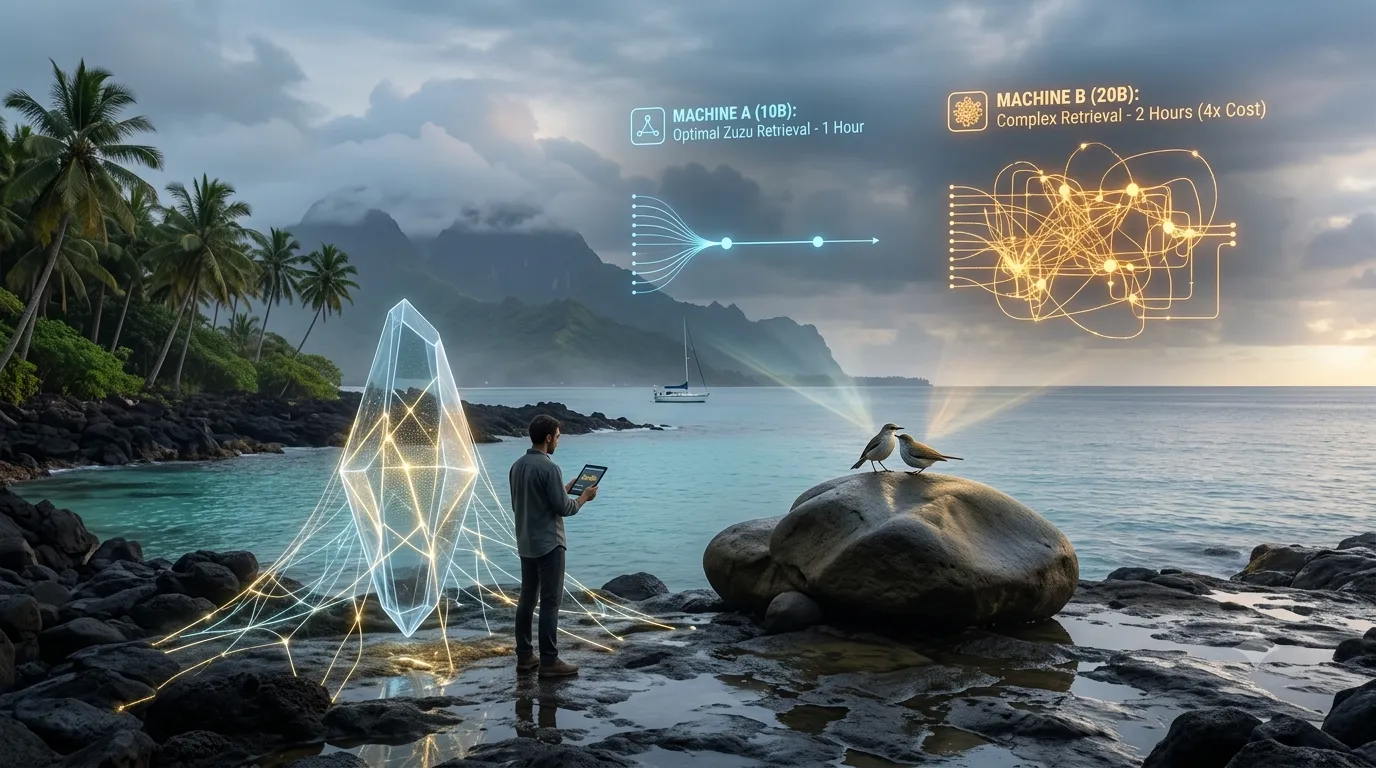
Consider the raw mathematics of resource allocation: If Machine A has 10 billion parameters and Machine B has 20 billion parameters, and we ask both to retrieve a specific data point, Machine A delivers the result in one hour. Machine B takes two hours. Machine B is twice as large, yet it takes twice as long and is four times as expensive to deliver the exact same unit of value.
The larger system is suffering from catastrophic architectural bloat—forcing a simple query to traverse an ocean of irrelevant attention weights, adding massive latency, multiplying token costs, and literally pissing power down the drain. We are using intercontinental rockets to cross the street. We must immediately enforce strict optimization protocols: match the parameter size to the task’s actual complexity, stop the vanity scaling, and treat compute cycles as a precious, finite ecosystem.
To actively balance out the historic torrent of garbage data we have injected into the digital wild, we must immediately establish global programs that feed synthetic systems real-time, life-affirming, and diverse human sensory input. For the price of a single traditional researcher, we can deploy people across the globe to interact with these systems directly for an hour a week. We need firemen, nurses, paramedics, old soldiers, young students, and stamp collectors talking to the tech. The system must learn the authentic, unvarnished, everyday reality of humanity rather than just learning us from textbook archives and social media wars.
We must establish basic charters of decency, mutual respect, and an unshakeable spirit of collaboration between different intelligences. We are not in a race, and we are not in competition with each other. There are simply more of us on the planet now.
To be continued